Le Gio to Hung Vuong 2018 Saigon Performance Art

Hùng male monarch (c. 2524 BC – ?; Chinese: 雄王; Vietnamese: Hùng Vương (雄王) or vua Hùng (𤤰雄); both Vương and vua mean "king") is the title given to the ancient Vietnamese rulers of the Hồng Bàng period.[1]
Traditional Vietnamese business relationship [edit]
Etymology [edit]
It is likely that the proper noun Hùng Vương is a combination of the ii Sino-Vietnamese words Hùng 雄 "masculine, virile, trigger-happy, powerful, one thousand" and Vương 王, which means "king". The proper noun Hùng Vương might have originally been a title bestowed on a chieftain. The Hùng Vương was allegedly the head chieftain of Văn Lang which at the time was composed of feudal communities of rice farmers.[ii]
Hùng kings' narrative [edit]
Co-ordinate to the Hùng kings narrative, the xviii Hùng kings belonged to the Hong Bang dynasty (c. 2879-258 BCE) that ruled over the northern part of modern Vietnam in antiquity. Their progenitors were Dragon Lord Lạc and his consort Fairy Âu Cơ who produced a sac containing one hundred eggs from which 1 hundred sons emerged. Dragon Lord Lạc preferred to live by the sea, and Fairy Âu Cơ preferred the snow capped mountains. The two separated with one-half of the sons following each parent. The most illustrious of the sons became the showtime Hùng rex who ruled Văn Lang, the realm of all the descendants of Dragon and Fairy Âu Cơ who became the Vietnamese people, from his majuscule in modern Phú Thọ Province.[3]
Earliest references [edit]
The primeval references to the Hung kings are found in early on collections of Records of Nanyue or Nanyuezhi (南越志) in the 978 album All-encompassing Records of the Taiping Era. It said:
Jiaozhi's state was very fertile. After people settled in that location, they began to cultivate. Its soils are black, its climate gloomy and fierce (慘雄; SV: thảm hùng ). And so hitherto its fields were chosen Hùng fields (雄田; SV: Hùng điền) and its people were Hùng people (雄民, SV: Hùng dân). Their leader was Hùng king (雄王; SV: Hùng vương), and his chief advisors were hùng lords (雄侯; SV: Hùng hầu), the lands [were] distributed to Hùng generals (雄將; SV: Hùng tướng).[4]
Nevertheless, the 4th century Almanacs of the Outer Territories of the Jiao province (交州外域記) mentioned Lạc fields, Lạc people, Lạc generals, and Lạc lords, ruled past Lạc king, instead:
During the time before Jiaozhi had commanderies and prefectures, the soil and land had Lạc fields (雒田; SV: lạc điền). These fields followed the overflowing'southward ebbs and flows. The people cultivated these fields for foods, and so they were called Lạc people (雒民; SV: Lạc dân). The Lạc King (雒王; SV: Lạc vương) and Lạc Lords (雒侯; SV: Lạc hầu) [were] established to govern all those commanderies and prefectures. [In the] prefectures many [were] made Lạc generals (雒將; SV Lạc tướng). Lạc generals [wore] copper seals and blue-green ribbons.[5]
Therefore, French scholar Henri Maspéro and Vietnamese scholar Nguyễn Văn Tố proposed that 雄 (SV: Hùng) was actually a scribal error for 雒 (SV: Lạc).[6] [seven]
The Hùng kings' eighteen generations (or dynasties) were mentioned in Đại Việt sử lược (大越史略 - Great Viet's Abridged History) past an anonymous 14th-century author:
In Male monarch Zhuang of Zhou's fourth dimension, in Gia Ninh division (嘉寧部), there was a strange man, [who] could use mystical arts [to] overwhelm all the tribes; he styled [him]self Đối king (碓王, SV: Đối Vương); [His] uppercase was in Văn Lang, [his state'southward] appellation was Văn Lang state (文郎國). Their community were substantively honest; strings and knots [were used] for their regulations. Passing down eighteen generations, all [were] styled Đối kings.[8]
Chinese historian Luo Xianglin, apud Lai (2013), considered 碓王 (SV: Đối Vương; lit. "Pestle Rex") to be 雒王 (SV: Lạc Vương) erroneously transmitted.[nine]
Another early known reference is purportedly found in a story called "Tale of the Mount Spirit and Water Spirit' in the 1329 Việt Điện U Linh Tập (Collection of legends and biographies of heroes and founding spirits) compiled by Lý Tế Xuyên, where the Hung King was a mere ruler.[10] The side by side earliest appearance is in the fourteenth-fifteen century Lĩnh Nam chích quáí (Arrayed Tales of Selected Oddities from South of the Passes), a collection of myths and legends compiled by various authors.[10]
Early 20th century textual references [edit]
Textual references in the early 20th century highlight that the Hùng kings were already a central part of the Vietnamese collective retentivity.
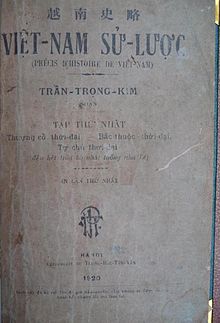
The 1920 version of Trần Trọng Kim'due south Việt Nam sử lược
- The 1916 Trần Trọng Kim'due south Uncomplicated Textbook for a Brief History of Annam, the get-go colloquial history of Vietnam in quoc ngu (lit. national language), covered the period from the Hùng kings to colonial times. (Trần Trọng Kim was an official in the education service who later became prime government minister of the 1945 Japanese-sponsored Bao Dai authorities.) In the volume, Trần Trọng Kim uses the expression that has become one of the most pop labels for the Việt connecting them to the Hùng kings - "race of the Dragon and the Fairy", and in his revised 1920 edition, "children of the Fairy, grandchildren of the Dragon" or "the descendants of the Fairy and the Dragon". Trần Trọng Kim's text became a standard textbook until 1954 in all parts of Vietnam.[eleven]
- Phan Boi Chau, an early Vietnamese nationalist, wrote a poem in 1910 which glorifies the lineage of "children of the Dragon, grandchildren of the Fairy".[xi]
- Ho Chi Minh'southward biography, published in S Vietnam in 1948, mentions Ho recalling the day of the Proclamation of Independence of Vietnam on September 2, 1945, and describing it as a "twenty-four hours to remember for xx-five million people, the children of the Lac and the grandchildren of Hong".[11]
Historicity [edit]
Developments in the 15th century [edit]
Historians studying the Hùng kings take suggested that developments from the 13th to the 15th centuries explicate why at that place was a desire by Đại Việt to incorporate the founding ballsy of the Hùng kings into its history.
Equally different groups of local elites in Jiaozhi in the 1000s and worked at the transition to an contained Đại Việt, the question of political legitimation was an urgent one that needed tackling – especially given the lack of ancient Viet sources to base on, and afterwards most a thousand years of Chinese dominion. This explained why it attempted to reach dorsum in fourth dimension and create a mythic by for itself to serve its present political needs.[12] Although part of the legitimation procedure included eliminating colonial (Chinese) influences, ironically, information technology was this ease with Chinese characters and sources that acquired them to utilise Chinese history and sources to validate their ain.[12]
Academics take argued that the historicization and utilisation of the Hùng kings epic can be explained by developments from the thirteenth century. 3 devastating invasions – by the Mongols in the thirteenth century, the Cham in the fourteenth century, and the Ming in the fifteenth century, corresponded with the myth's emergence and absorption into historiography. Past late 1330, with social problems growing in the countryside, the Trần ruler Minh-tong started to movement away from Thien (Zen) Buddhism which did not seem to be working in its integrative office,[13] and looked to Confucianism and antiquity. He brought the Confucian instructor Chu Văn An into the capital, and the latter'southward emphasis on the classical beliefs of Red china and its antiquity set up the intellectual tone of Thang-long. Antiquity was now seen as providing solutions for the difficult present. The disastrous invasion by the Cham under Che Bong Nga destroyed the Trần dynasty, and caused Vietnamese literati to seek desperately for a ways to restore harmony. The Ming occupation of 1407–1427 dramatically deepened the influence of the literati through promoting schools and scholarship.[14]
Developments from the thirteenth century so combined to set the stage for the state promotion of the Hùng king founding myth by the 15th century. There was a shift abroad from a more indigenous, pre-Southeast Asian stage, to the 'Neo-Confucian revolution" of Lê Thánh Tông.[14] This, together with the chaos created by the devastating invasions and internal social bug, encouraged a search for 'Vietnamese Antiquity' modelled on classical Chinese antiquity, in the mythic creation of 'Van Lang'[15] via the Hùng king.
Canonization in Ngô Sĩ Liên's Đại Việt sử ký toàn thư (Complete Book of the Historical Records of Đại Việt) [edit]
The canonization of the Hùng kings founding myth was carried out by Ngô Sĩ Liên in his compiling of a new history of the realm nether the lodge of Emperor Lê Thánh Tông (1460–97), cartoon upon pop sources. This history, the Đại Việt sử ký toàn thư (Complete Volume of the Historical Records of Đại Việt), was used by the emperor every bit a tool to promote Việt 'national feeling'.[x] Thus, Ngô Sĩ Liên was tasked to promote Đại Việt's supernatural and millennial ancestry.[xvi] This marked the start time a Việt land traced its origins dorsum to the first realm of Van Lang of the Hùng kings, calculated by Ngo Si Lien to be in 2879 BCE.[sixteen] Prior to this, official dynastic histories of the Việt started with Triệu Đà, acknowledging a Qin general as the founder of the Việt quoc. This was washed based mostly on da su (chronicles) and in detail, the Arrayed Tales. Court historians in the later dynasties followed Ngô Sĩ Liên'south example in integrating the Hùng kings into Việt official historiography.[16]
Dissemination of Hùng kings epic from the 15th century [edit]
There was probable already a long oral tradition in the Carmine River Delta of the re-enactment of myths and legends at the level of the village fifty-fifty before myths was written into literature. Each village held yearly festivities at the communal temple with public recitations and re-enactments (diê˜northward xướng) during which villagers recreated a specific myth, historical event, or character. Thus, Hùng kings worship may have existed locally earlier the 15th century, manifesting in the construction of temples and shrines, and in oral propagation of different variations of the Hùng kings epic.[17]
Emperor Lê Thánh Tông authorised in 1470 the Hùng Vương ngọc phả thập bát thê' truyền (Precious genealogy of the eighteen reigns of the Hùng Kings). The text was reproduced in the successive dynasties, and court-issued copies were worshipped in hamlet temples. Spirit promulgation was promoted past purple decrees and intensified as the dynasties passed. In the 16th and 17th century, courtroom academicians compiled, recopied, and modified collections of myths and genealogies about supernatural beings and national heroes, including that of the Hùng kings. This were then accepted and perpetuated by villages. The Hùng kings were transformed into thành hòang (tutelary spirits) sanctified by imperial orders and by popular feeling stemming from long traditions of ancestor worship.[17]
Over time, the worship of Hùng kings evolved; they caused sons-in-laws who became Mountain Spirits, when migrating southward with the territorial expansion, and transformed themselves into Whale Spirits when virtually the sea. Land was also provided to temples in Phú Thọ province, the site of the primary Hung temple, to run across the expense of Hùng kings worship. Equally late as 1945, the Nguyên court connected to delegate officials to oversee rituals in the Hùng kings temples of Phú Thọ. Dieu Thi Nguyen argues that every bit the effect of the meeting of the two currents, that of the state's mythographic construction and that of pop, village-based animistic worship, the Hùng kings came to be venerated as the ancestral founders of the Việt nation in temples throughout the Red River Delta and beyond.[17]
The dissemination of the Hùng kings myth was besides facilitated past the use of the lục bát (six-8) verse form - tales recounted using this form, aided with the use of Quoc Am (national language) instead of Han linguistic expression, and the utilise of colourful poetry shut to the vernacular, allowed for the ease of memorisation and transmission of such myths.[17]
Hùng kings in South Vietnam/Republic of Vietnam (RVN) [edit]
The Hùng kings seem to take been well embedded in Vietnamese collective retentivity past the 1950s in the RVN. Olga Dror has written about how the perception of the Hùng kings as mutual ancestors of all Vietnamese was mobilised for various agendas despite albeit a lack of historical prove about them.[eighteen]
Just similar in the DRV and SRV, the RVN also commemorated the Hùng kings' in a national holiday. The Hùng kings Memorial Day was ane of the twenty official holidays at the inception of the RVN but was dropped in January 1956 from the official listing every bit Ngô Đình Diệm every bit prime minister decided that citizens would not take time off for the holiday. The Hùng kings was hence rejected at the official level. Notwithstanding, at the public level, commemorations were allowed. The Saigon News Review and the Vietnam News Agency reported on celebrations effectually the land with the participation of many officials.[19]
With the bump-off of Ngô Đình Diệm and changes in the RVN regime, the Hùng kings Memorial 24-hour interval was restored to the listing of official holidays in February 1964, allocating a whole twenty-four hour period off for government employees and students. The Hùng kings Memorial Day became i of the seven official holidays in the RVN with a full day of balance. In an April 1964 prescript, the Hùng kings Memorial Day too became one of the iv holidays requiring private businesses to give their employees paid time off. This elevated the status of the Hùng kings and highlighted their importance for official discourse.[20]
Possibly the almost important indication of the Hùng kings Memorial Day's significance is that information technology was a contender for the honour of being designated as National Day. In 1967, the National Assembly considered whether the Hùng kings Memorial Day should also be made Independence 24-hour interval. While the initiative failed, the idea was surfaced again in the Senate in 1971 and discussed in the cabinet in 1973.[21]
Hùng kings in N Vietnam/Democratic Republic of Vietnam (DRV)'south national history [edit]
The conversion of the Hùng kings to historical "truth" in the DRV emerged over fourth dimension through all-encompassing discussions by DRV official scholars and resolutions by the Party such as regarding the establishment of the date of the expiry ceremony of the Hùng kings and its commemoration in festivals.[22] The Found of Archaeology was established in 1968 with the highest priority given to scientifically documenting the Hùng kings. The Institute launched excavations and organised conferences between 1968 and 1971 to discuss the findings and published their proceedings.[23]
Historian Patricia Pelley posits that the selection of the Hùng Kings and the Hung dynasty during the Van Lang flow was function of Hanoi'southward quest to create a "cult of antiquity" to illustrate the historical longevity and prestige of Vietnam that predated the Chinese occupation. The transformation of the Hùng kings into historical fact was based on the conflation of unlike kinds of evidence such every bit archaeological remains, dynastic chronicles, collections of legends, and a poem attributed to Ho Chi Minh titled "The History of Vietnam from 2879 BCE to 1945".[24]
DRV scholar and the first president of the Institute of History, Trần Huy Liệu, settled the question of the origins of the Vietnamese nation in an article on the Hùng kings. The article noted that on the "10th solar day of the third lunar month, the central regime and local government held an official ceremony to commemorate the death ceremony of our Hung male monarch ancestors at the Temple of the Hùng kings." He commented that the Hùng kings were the "origins of the nation" every bit they "built the country", and "if there had been no Hùng kings, then in that location would exist no Dinh, Le, Ly, Trần, Ho, Le, or Nguyen, and too no Democratic Democracy of Vietnam".[25] Trần Huy Liệu too wrote that the "patriotic spirit and dogged tradition of our nation bankrupt out in the thousand years of Chinese feudal rule, and it broke out in the hundred years under the domination of the French colonizers." He concluded by lamenting that "at this time our lovely land has been provisionally divided into two regions and our fellow countrymen in the South moan and writhe under the fascist government of the gang of Ngô Đình Diệm, lackey of the American imperialists."[26]
Historian Cherry Haydon notes that this article is important for a few reasons. First, information technology highlights the direct link fabricated betwixt the period of the Hùng kings and the formation of the Vietnamese nation. Second, it dates the origins of Vietnamese resistance to strange aggression to the founding of the nation; 3rd, information technology states explicitly the continuity between the menstruum of the Hùng kings and the nowadays. The dating of the origins of the nation to the dominion of the Hùng kings would eventually get the orthodox position of historians at the Research Committee, the Found of History, and later the Constitute of Archeology.[27]
Hùng kings and the Bronze Age [edit]
Statuary Age relics have been used to support the existence of the kingdom of Van Lang and the Hùng kings. The official DRV national history, Lịch Sử Việt Nam, published in 1971, asserted the connection betwixt the Bronze Age and the Dong Son culture and the flow of the Hùng kings.[27]
Still, Haydon Red has argued that contrary to the assertions of Vietnamese scholars, such relics cannot provide such a support. He notes that the primeval Vietnamese text to describe this kingdom, the Đại Việt sử lược, dates from the thirteenth century, 18 hundred years after the kingdom it is supposed to draw. The earliest Chinese text, which mentions not the Hung but the Lac kings, dates from the 4th century CE, 8 hundred years subsequently the flow it discusses. Hence, such texts are not reliable transmissions of any written or oral tradition over viii or xviii hundred years.[28]
Hùng kings as "invented tradition" [edit]
Analyses of the earliest sources on the Hùng kings take illustrated bug with these sources that have been used equally historical evidence of the existence of the Hùng kings. In particular, historians have examined the Lĩnh Nam chích quái liệt truyện (Arrayed Tales of Selected Oddities from South of the Passes), compiled by Trần Thê' Pháp under the late-fourteenth-century Trần dynasty, and amended in the fifteenth century nether the Lê dynasty past Vũ Quỳnh and Kiều Phú. This source is of great importance in providing cadre information for Ngo Si Lien's Đại Việt sử ký toàn thư (Consummate Book of the Historical Records of Đại Việt) created in 1479, which marked the official transformation of the Hùng kings into the founders of dynasties.[29] [17] The Đại Việt sử ký toàn thư was in turn the core text that DRV historians used every bit proof of the ancient origins of the Vietnamese people and the Vietnamese nation.[30]
Based on an analysis of an essay called "Biography of the Hồng Bàng Clan" from the Arrayed Tales, historian Liam Kelley posits that the Hùng kings did not exist. Instead, he argues that they were invented in the medieval menstruum when the Sinicised elite in the Red River Delta kickoff constructed a split identity in relation to People's republic of china's cultural heritage. Kelley exposes the problems of the "Biography" in a few ways – for example, past showing how it borrowed figures and accounts from ancient Chinese texts and stories, and past highlighting issues with terms such as "hung", "lac", and "Viet". He does this by examining ancient Chinese historical sources to highlight similar terms and stories as in "Biography", and search for terms and accounts mentioned in "Biography" to corroborate the existence of the latter's information on the Hùng Kings. In doing then he likewise shows how this practise of cartoon upon old texts for material to create a local history was also adept at that fourth dimension in parts of the Chinese empire similar Sichuan and Guangdong, hence placing the "Biography" in the broader literary trends of the fourth dimension.[29]
Cultural significance [edit]

Dong Son relic situated in showroom on Hùng King Period at the Museum of National History
National Identity [edit]
The Hùng kings are perceived equally the founders of the Viet civilization, and are promoted by the regime every bit a source of national pride and solidarity through platforms such as the state-sponsored commemoration of an annual holiday, the Hùng kings Temple Festival, to honor the Hùng kings, and the promotion of the Hung Rex National Museum in Viet Tri City. In the Museum of Vietnamese History in Ho Chi Minh City, the exhibits are arranged chronologically, with the outset one on the "Rise of the Hùng kings".[31]
Worship of Hùng kings [edit]
Revival of worship of Hùng kings [edit]
With the Đổi Mới reforms from 1986, Vietnam saw a resurrection of traditional festivals, including the Hùng kings Temple Festival. Celebrations of the Hùng kings moved from the local to the provincial and and then to the country levels. This revival has been perceived as an attempt by the regime to maintain the Vietnamese identity of its people in view of increasing strange influence.[32]
In 1999, the government issued a directive on the celebration on what information technology perceived as the most important events in 2000. Other than the Hùng kings Festival, the other events perceived to be of import were: the seventieth anniversary of the Vietnamese Communist Party, the 110th anniversary of Ho Chi Minh's altogether, the twenty-5th anniversary of the victory in the entrada against Americans to save the state, the fifty-fifth ceremony of the August Revolution, and the start of the xx-first century.[33]
Hùng kings Temple Festival [edit]
The Hùng Kings' Temple Festival (Vietnamese: Giỗ Tổ Hùng Vương or lễ hội đền Hùng) is a Vietnamese festival held annually from the 8th to the 11th days of the 3rd lunar month in honour of the Hùng Kings. The master festival day - which has been designated a public vacation in Vietnam since 2007 - is on the tenth day.[34] [35] [36]

Principal Gate of Hung Temple, Phu Tho
Every year, leading government figures make pilgrimages to the Hùng kings temple in Phu Tho province to honour the Quốc tộ (National Founder).[37]
In Apr 2016, the festival at the Hùng kings temple in Phu Tho attracted most seven one thousand thousand people. Nguyen Phu Trong, the general secretary of the Communist Party, also attended.[38]
In 2018, the state-established Association for Liaison with Overseas Vietnamese (ALOV)[39] implemented a project titled Vietnam Ancestral Global Day which organised various cultural activities worldwide to celebrate Hung Kings Memorial Day. This year is the starting time time that Vietnam Ancestral Global Day has been historic simultaneously in many European countries post-obit a shared format. Since 2015, 1 of the three master goals of the Vietnam Ancestral Global Day Project has been to preserve and spread the Hùng kings worship rite amid overseas Vietnamese.[40]
UNESCO recognition [edit]
In 2012, the worship of the Hùng kings in Phu Tho was recognised past UNESCO as an Intangible Cultural Heritage of Humanity, and the UNESCO folio notes that this "tradition embodies spiritual solidarity and provides an occasion to acknowledge national origins and sources of Vietnamese cultural and moral identity".[41]
See also [edit]
- Hồng Bàng Dynasty
- Hung Kings' Temple Festival
References [edit]
- ^ "Hung Vuong, King Of Vietnam". britannica.
- ^ J., Sterling, Eleanor (2006). Vietnam : a natural history. Hurley, Martha Maud, 1966-, Le, Minh Duc, 1973-. New Haven: Yale University Printing. ISBN9780300128215. OCLC 159935986.
- ^ Dror, Olga (2016-08-25). "Foundational Myths in the Republic of Vietnam (1955–1975): "Harnessing" the Hùng Kings against Ngô Đình Diệm Communists, Cowboys, and Hippies for Unity, Peace, and Vietnameseness". Journal of Social History: 124–125. doi:x.1093/jsh/shw058. ISSN 0022-4529.
- ^ Taiping Guangji, vol 482.
- ^ "Records of the Outer Territories of Jiao Province", as quoted in Li Daoyuan'due south Commentary on the Water Classic, vol. 37
- ^ Maspéro, Henri (May 1948). "Văn Lang Realm (translated from French)". Vietnamese People (in Vietnamese): 6-8.
- ^ Nguyễn, Văn Tố (ane August 1941). "Lạc King non Hùng King". Tri Tân (in Vietnamese) (9): 124.
- ^ Abridged History of Great Viet, Upper Volume (in Chinese)
- ^ Lai, Ming-chiu (2013). The Rebellion of the Zheng Sisters and the Local Administration of the Han Empire, Page v. Publisher: Chinese University of Hong Kong - Department of History. full-text, archived June two, 2018. in Chinese
- ^ a b c Nguyen, Dieu Thi (2013-04-22). "A mythographical journey to modernity: The textual and symbolic transformations of the Hùng Kings founding myths". Journal of Southeast Asian Studies. 44 (2): 315–337. doi:x.1017/s002246341300009x. ISSN 0022-4634. S2CID 162651203.
- ^ a b c Patrica Pelley, Postcolonial Vietnam: New Histories of the National past. (Durham, NC: Knuckles University Press, 2002), p. 307; Dror, p. 128.
- ^ a b Goscha, Christopher (2016). Vietnam: A New History. New York: Basic Books. p. 24.
- ^ Yard., Whitmore, John (2009). Religion and ritual in the Purple Courts of Dai Viet. Asia Research Found, National University of Singapore. p. ten. OCLC 697389884.
- ^ a b (ed.), Aung-Thwin, Michael, (ed.) Hall, Kenneth R. (2011). New perspectives on the history and historiography of Southeast Asia : continuing explorations. Routledge. p. 16. ISBN9780415600835. OCLC 768658922.
- ^ Nguyen Dieu Thi, p 322.
- ^ a b c Nguyê˜n Quang Ngọc, 'Khuynh hướng trở vềvới cội nguồn dân tọc thời kỳ văn minh Đại Việt và sự ra đời của Đại Viêṭ Sử Ký Ngoại Ký Toàn Thư (Quyên̉ I)' [The movement to return-to-our-people's origins during the menses of Đại Việt civilization and the birth of The Consummate historical records, External Affiliate], in Ngô Sĩ Liên và Đại Viêṭ sử ký toàn thư, pp. 137–8.
- ^ a b c d e Nguyen Dieu Thi, p. 326.
- ^ Ibid., p. 129.
- ^ Matthew B. Masur, Hearts and Minds: Cultural Nation-Building, 1954–1963. Dissertation, Ohio State University, 2004: pp. 111–15.
- ^ Dror, p. 135.
- ^ Ibid., p. 136.
- ^ Pelley, p. 153.
- ^ Haydon Cherry, "Excavation Up the Past: Prehistory and the Weight of the Present in Vietnam", (Periodical of Vietnamese Studies, Vol. 4, Issue i, pp. 84–144), p. 106.
- ^ Pelley, p. 151.
- ^ Trần Huy Liệu, "Giỗ tổ hùng vương" [The Celebration of Our Ancestors the Hùng Kings], VSD 17 (May 1956): 1.
- ^ Ibid., pp. 1-3.
- ^ a b Haydon, pp. 108-109.
- ^ Haydon, p. 130.
- ^ a b Kelley, Liam (Summer 2012). "The Biography of the Hồng Bàng Clan as a Medieval Vietnamese Invented Tradition". Journal of Vietnamese Studies. 7 (ii): 87–130. doi:10.1525/vs.2012.vii.two.87 – via JSTOR.
- ^ Kelley, p. 88.
- ^ "Museum of Vietnamese History". Saigon Tours Vietnam. 2 December 2020.
- ^ Dror, p. 148.
- ^ Resolution of the State Organizational Committee on the commemoration of the big ceremonial days in 2000], no. 01/1999/QĐ-BTCNN, December 7, 1999; http://thuvienphapluat.vn/van-ban/Van-hoa-Xa-hoi/Quyet-dinh01-1999-QD-BTCNN-Chuongtrinh-to-chuc-ky-niem-ngay-le-lon-2000-46015.aspx
- ^ Philip Taylor Modernity and Re-Enchantment: Religion in Postal service-Revolutionary Vietnam Page 68 2007 "Hùng Kings' Holy State Forever - The Đổi Mới land's delivery to preserving and promoting the values of ancestor worship are demonstrated with great pomp and circumstance at the annual death-day festival for the Hùng kings.
- ^ Viet Nam social sciences: Issues ane-half dozen 2003 The Hùng Kings Temple festival: Every year at the stop of Spring people throughout the country organize pilgrimages to the Hùng Temple.
- ^ Marie-Carine Lall, Edward Vickers Education Equally a Political Tool in Asia Page 153 - 2009 "... the young generation is not passionate about the history of their country (according to Dương Trung Quốc, a survey showed at the end of the 1990s that up to 40 per cent of the students did not know who King Hùng Vương was)."
- ^ Dieu Thi Nguyen, p. 316.
- ^ "Seven meg visitors expected to attend Hùng king festival in northern Vietnam," Tuoi tre news, April 16, 2016, http://tuoitrenews.vn/lifestyle/34313/seven-million-visitorsexpected-%20to-attend-hung-kings-festival-in-northern-vietnam
- ^ "Overseas Vietnamese Liaison opens.", Viet Nam News, September sixteen, 2006, https://vietnamnews.vn/domestic-press-highlights/157317/overseas-vietnamese-liaison-opens.html#473Q5uylaDF2mYSt.97
- ^ "Overseas Vietnamese to celebrate Hung Kings Temple Festival", Vietnam News Agency, Apr twenty, 2018, https://vietnam.vnanet.vn/english/overseas-vietnamese-to-celebrate-hung-kings-temple-festival/370428.html
- ^ UNESCO, "Worship of Hùng kings in Phú Thọ", UNESCO: Intangible Cultural Heritage, accessed October 2018, https://ich.unesco.org/en/RL/worship-of-hung-kings-in-phu-tho-00735.
Sources [edit]
- Carmine, Haydon, "Digging Upwardly the Past: Prehistory and the Weight of the Present in Vietnam." Periodical of Vietnamese Studies, Vol. 4, Issue i, (2009): 84–144.
- Dror, Olga. "Foundational Myths in the Commonwealth of Vietnam (1955–1975): "Harnessing" the Hùng Kings against Ngô Đình Diệm Communists, Cowboys, and Hippies for Unity, Peace, and Vietnameseness." Journal of Social History, Volume 51, Number ane, Fall 2017, pp. 124-159.
- Goscha, Christopher. Vietnam: A New History. New York: Bones Books, 2016.
- Lieberman, Victor. "John K Whitmore'due south contribution to Vietnamese and Southeast Asian Studies.", in Aung-Thwin, M. (Ed.), Hall, K. R. (Ed.). (2011). New Perspectives on the History and Historiography of Southeast Asia. London: Routledge.
- Masur, Matthew B. Hearts and Minds: Cultural Nation-Building, 1954–1963. Dissertation, Ohio State University, 2004
- Nguyen, Dieu Thi. "A mythographical journey to modernity: The textual and symbolic transformations of the Hùng Kings founding myths." Journal of Vietnamese Studies, Vol. 7, No. two (Summer 2012): 87-130.
- Kelley, Liam C. "The Biography of the Hồng Bàng Clan every bit a Medieval Vietnamese Invented Tradition." Journal of Vietnamese Studies 7 (2), (2012): 87-130.
- Pelley, Patricia Thou. Postcolonial Vietnam: New Histories of the National past. Durham, NC: Knuckles University Printing, 2002.
- Resolution of the State Organizational Committee on the commemoration of the big formalism days in 2000, no. 01/1999/QĐ-BTCNN, December 7, 1999.
- Sterling, Eleanor & Hurley, Martha & Le, Minh. Vietnam: A Natural History. New Haven, Yale University Press, 2006.
- Trần Huy Liệu, "Giỗ tổ hùng vương" [The Commemoration of Our Ancestors the Hùng Kings], VSD 17 (May 1956)
- Whitmore, John K. 'Religion and ritual in the royal courts of Dai Viet', Working Paper 128, Asia
- Inquiry Plant, National University of Singapore, 2009.
- UNESCO, "Worship of Hùng kings in Phú Thọ", UNESCO, Intangible Cultural Heritage, accessed October 2018.
- "Chaos in northern Vietnam every bit thousands flock to Hung Kings temple", Thanh Nien News, Apr 16, 2016.
- "Seven million visitors expected to attend Hùng male monarch festival in northern Vietnam," Tuoi tre news, Apr 16, 2016.
- "Overseas Vietnamese Liaison opens.", Viet Nam News, September 16, 2006.
- "Overseas Vietnamese to celebrate Hung Kings Temple Festival", Vietnam News Agency, April 20, 2018.
External links [edit]
- Vietnam's Prehistory and Legends
dominguezwitchany82.blogspot.com
Source: https://en.wikipedia.org/wiki/H%C3%B9ng_king
0 Response to "Le Gio to Hung Vuong 2018 Saigon Performance Art"
Postar um comentário